Earlier this year I shared a printable map of eight locations in downtown Rochester, NY that are notable in the history of the religion of Modern Spiritualism. While that map includes a lot of information, I want to walk all of that out a bit more in this blog post. [Download that map here]
Background
Spiritualists celebrate the founding of their religion on March 31, 1848. It was on this day that the two youngest Fox sisters, Maggie (Margaretta) and Katie (Catherine/Catie/Kate/Kathie/Cathie), first communicated with a disembodied spirit in their small family home in Hydesville (an area since incorporated into the city of Newark), NY.
The Fox Sisters did not invent the concept of Spiritualism, but they did popularize it in a way others had not. And, the reason for that dates to more than 20 years before those events would unfold in their humble home.
1825 was a very important year in New York State. On October 26 of that year, the Erie Canal was finally complete. It took eight years to dig a canal between the Hudson River, near the state capital of Albany, all way west to Buffalo, emptying into the Niagra River at Lake Erie.
The canal stretched 363 miles and utilized more than 30 locks, allowing, for the first time, water travel from the Atlantic Ocean to the Great Lakes. The canal became an expressway of its day, revolutionizing the concept of travel. The canal also helped shape the state, with towns and villages sprouting up along the waterway and locks. The canal’s peak year was 1855, when 33,000 commercial shipments traveled along its length.
It wasn’t just commerce that flourished along the canal, though. New ideas and concepts ricocheted along the internet of its day and, before long, Western NY was overwhelmed with religious fervor. Charles Grandison Finney referred to the area as a “burnt district,” describing how the flames of religious revivals had burned through again and again, leaving no one to convert.
This Burned Over District at the Western end of the Erie Canal became the home of many religious and social reform movements, including Mormonism, the Abolition of Slavery, the Shakers, Woman Suffrage, and others. New thoughts and ideas about creating a more just world flowed freely through the towns and farms of New York state, and it was in this bed of possibility that the youngest sisters Fox found themselves.
After the two appeared to communicate with an unseen force by way of “raps,” they moved in with their much older sister, Leah, who was living nearby in Rochester, NY. The girls continued to communicate with these unseen forces who would rap against walls and tables in response to their questions. This phenomena became known as the Rochester Rappings.
All three sisters would eventually move to New York City, dying and being buried there. An incredible amount of drama and intrigue surrounds all three sisters, but I was interested to learn more about their time in this city: Rochester.
Having grown up in the next county over, and spending the last decade plus in Rochester, I’ve heard my fair share about the sisters. I was even a card-carrying member of a Spiritualist church in the city for a while. Despite Rochester being the place where the religion found its footing, there is remarkably little here to suggest that. I found that Spiritualists were largely disinterested in the Fox Sisters (I assume because of their infamous confession that they faked the entire thing, and then their recantation of that confession), and everyone else rolled their eyes when they were brought up.
I should note that I’m not engaging in this project because I’m a believer in Spiritualism. That’s not to say I believe it to be a sham, either. I don’t believe that the validity of the religion or its founding is, in any way, important or relevant to the fact that this religious movement deeply effected the society around it, and has had long-reaching effects on other religious and social movements. In her book Radical Spirits: Spiritualism and Women’s Rights in Nineteenth-Century America, author Ann Braude lays out a compelling case for Spiritualism to provide the foundation for the later legs of the Woman Suffrage movement. In fact, in the mid 1800s, you’d likely find Suffragists, Abolitionists, Temperance advocates, and Spiritualists hanging out at the same meetings and gatherings, their ideas and beliefs blending and flowing from one movement to the other.
All of this is to say that Spiritualism is part of a much larger picture and to dismiss its impact is to do a great disservice to our history.
In Rochester
Being that the Fox-inspired Spiritualist movement was known as the Rochester Rappings, I assumed that the sisters were in this city for quite a while, conducting seances and public demonstrations all over. Imagine my shock when I learned that they were in Rochester as Spiritualists for like two seconds.
1848-1852.
Site #1: The eldest Fox sister, Leah, was already living in Rochester when her sisters started rapping with the dead out in Hydesville. She at the time was known as Leah Fish. Her first husband apparently gave her a daughter, another animal-based surname, and then left New York State forever. I’ve been unable to find any record of him, or of Leah’s daughter at this point. After her husband left her, Leah supported herself entirely by teaching music.
The earliest reference of Leah I’ve been able to find so far is in the 1847 Rochester City Directory:

Leah (born Ann Leah) was living in a little house on Mechanics’ Square. The square sat in the center of what was, at the time, known as the Bush & King Tract. It was a brand new mixed-use neighborhood just west of downtown Rochester. Most of the plots were still empty, but the neighborhood was designed around a large public square. By 1888 the park was known as Madison Park. By 1910 the park would be redesigned by Frederick Law Olmstead. Today it’s known as Susan B. Anthony Square.
Before Susan B. Anthony, her sister Mary, and her mother Lucy Read would move into 17 Madison Street, Leah Fox was struggling to survive as a single mother in the early 19th century just feet away.
Even though we know Leah’s exact address at the time, 11 Mechanics’ Square, we don’t know exactly where that address was located. Apparently lot numbering around public squares was a bit of an anomaly at the time, and their unique conventions didn’t last much longer into the century. Today we don’t know what those conventions were.
The best we can say is that 11 Mechanics’ Square was likely adjacent to the square itself.
This is completely made up on my part, be aware of that, but my belief is that the house stood on what is today either Madison Park North or Madison Park South. Madison Street and King Street, the West and East boundaries of the park, respectively, already existed at the time. The North and South boundaries changed names several times, and I wouldn’t be surprised if, in 1847, they were simply “Mechanics Square.”
But, even if all that stuff I made up were true, that still doesn’t tell us anything about where the house actually stood. I hope that a more specific location can be identified in the future, but I’m not going to hold my breath.
Regardless of the exact plot of dirt, we know our story is so far centered in today’s Susan B. neighborhood.
It was in early May 1848 that Leah was spending time visiting with some friends, when one friend asked her if she was related to the Fox family out in Hydesville. It is during this visit that Leah’s life changes forever when she reads an account of the extraordinary events taking place at her family’s small home. She initially couldn’t believe that her youngest sisters were talking to some disembodied spirit, but was forced to accept it as truth when she read the signed statements by her parents and her brother David. She decided in that moment to travel, by way of the Erie Canal, to Newark, NY, in Wayne County, to visit her family in Hydesville.
Apparently, the canal was the fasted option for travel at the time. There was not yet a connecting railroad between Rochester and Syracuse, a path that would have deposited Leah close to her destination.
Finally the canal boat docked in Newark and Leah immediately ran to her family’s home. Though, upon finding it, the house was deserted.
She traveled to her brother David’s house and found the whole family there. They were concerned it was the house itself that was haunted, so they all left. It was clear, though, that this was not a permanent solution. The family speculated that while the house may be haunted, it’s the youngest daughters being together that encourages the spirits to rap and bang. Leah offered to separate the girls by taking Katie and Lizzie (Leah’s daughter, who was apparently staying with the family in Hydesville) back to Rochester.
As the trio traveled back to the city via canal, they learned that their hypothesis was incorrect. Knocks and raps followed them all the way home but, since canal travel is noisy, no one save the three were aware of their immaterial companions.
Once they arrived at Leah’s home on Mechanics’ Square, the phenomena continued. Rapping, banging, extremely loud noises that shook the windows, touches, and even objects being shaken around kept the three on edge all night.
This went on for another day, coming to a terrible apex where it sounded like tens of spirits were performing for an audience of many more spirits. The noise was deafening and Leah was scared for her life. She decided that, somehow, her home must also be haunted now, the spirits perhaps awoken by the presence of her sister.
Mechanics’ Square, or Susan B. Anthony Square, was the home to the first spirit rappings in all of Rochester.
Site #2: Deciding the house the issue, Leah quickly moved, with Lizzie and Katie, to a rental unit on Prospect Street (the house was rented from Mr. J. B. Bennett, the landlord). The Fox family had, after all, discovered through communicating with the spirit in their Hydesville home, that the spirit was a victim of murder and was buried in the basement. Therefore, Leah assumed her home in Rochester was also the site of some secret crime. The unit on Prospect, though, was a new build and no one had lived there before.
We do not know the address of the Prospect Street property, but some clues from Leah’s book gives an idea of where it may have been located.
Notably, Leah says that the rental unit backed up to the old Buffalo Road cemetery, and that that fact caused her to be pretty uncomfortable.
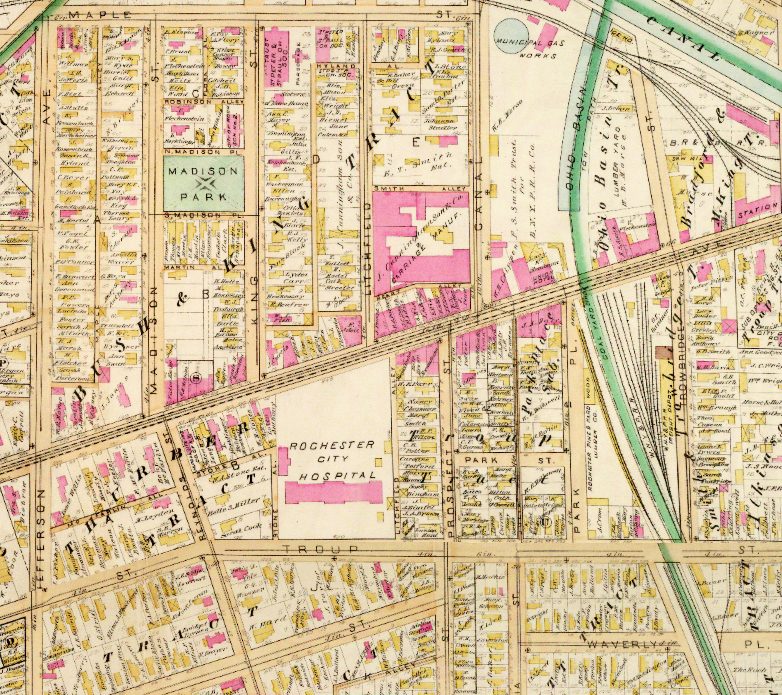
This is a map from 1888, the earliest I can easily find digitally. Madison Park is the green space that was once Mechanics’ Square. The area marked as Rochester City Hospital was initially the Buffalo Road Cemetery, but the graves were moved to Mt Hope in 1859 so the hospital could be built. We can also see that Prospect Street connects Troup Street to West Main (or, at the time, Buffalo Road). The stretch of Prospect is, today, a pedestrian path.
Leah also states that the unit consisted of two houses on one foundation. So, a duplex, essentially.
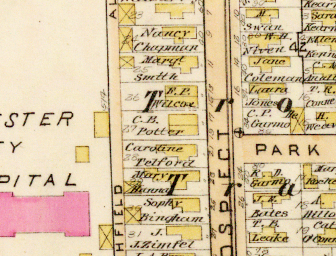
In this zoomed in image, you can see two plots, adjacent to the Prospect/Park intersection, that appear to show two individual units stuck together.
Leah, Lizzie, and Katie may have stayed in one of these properties. She said the house was “nearly finished,” so I don’t think it’s unreasonable to think that the houses on the 1888 map could be the same standing in 1848. Just beyond the alley to the West stood the cemetery, including the grave of Nathanial Rochester, the city’s namesake.
Today, these plots would likely be on space occupied by 18 and/or 24 Cunningham Street, two units in the Anthony Square apartment complex.
Leah, Lizzie, and Katie survived the first night in the new Prospect Street house without any unworldly incident at all. So, the other sister, Margaret (Maggie), and the mother of the sisters, came the next day from Hydesville to ensure the women were settling in well.
The first night, though, that all five women stayed in the house, the spirits got to work terrifying them. Even, to the great shock of the Fox family, lifting up their beds (with the women in the beds!) and dropping them back onto the floor with a great bang. Seeing that they needed help to figure out this problem, they called on long-time family friend, Calvin Brown. Calvin agreed to stay with the family, but thought that the spirits were evil in nature, so he asked the women to not encourage the communication in any way.
For some time Calvin stayed with the family, and the spirits absolutely tortured them all. Calvin was often the brunt of their efforts and, eventually, Calvin went off with his military company, possibly finding military exercises a more relaxing experience than staying with the Fox family.
It was during this time that the family was at the end of their rope. One of my favorite quotes from the book illustrates the fear and confusion of the time:
Often did my dear anxious mother exclaim— “What have we done? What have we done, that we should be so tormented? Dear children, pray to God to have mercy upon us.”
My little sister Katie would sometimes say, “I can’t pray, I feel more like swearing.“
The Missing Link in Modern Spiritualism by Leah Fox Underhill (1885), pg 45
Finding they still needed help, the Foxes reached out to their friends, Amy and Isaac Post. The Posts initially thought the Fox women to be under some sort of mental delusion, but after inviting the women to the Post’s own home and seeing the manifestations for themselves, they became believers, and started to invite friends over to see what the Fox girls could do.
By the time Calvin had returned, a new family had moved into the other half of the duplex, and they were very unhappy with all the racket the Fox family made. The husband of this family accused the Fox women of being ventriloquists, and said if he heard any more rapping, he’d have them all arrested. Apparently, the spirits liked this challenge, and started getting louder than ever. Books were thrown around, furniture was shoved across the floor, and, again, terrible loud bangs and explosions came from the roof. Leah was afraid the roof would collapse on them.
It was during this intense spirit assault that Isaac Post reminded Leah that her brother David Fox had come up with a way to use the alphabet as a way to communicate with the spirits. It was through this alphabet method that they had learned, months earlier, that the spirit in the Hydesville house was a murdered peddler.
Using this alphabet method seemed to be exactly what these spirits wanted. The crashes and bangs stopped, and eventually the Fox sisters spelled out the first spirit message communicated within the city:
“Dear friends, you must proclaim these
truths to the world. This is the dawning of
a new era; and you must not try to conceal
it any longer. When you do your duty,
God will protect you; and good Spirits will
watch over you.”
This communication marked a significant change in the trajectory of the hauntings of the Fox Sisters. The spirits indicated a way to express they want to communicate via the alphabet, and we had then all the pieces of a successful mediumship career for the sisters. However, the sisters did not, apparently, move quickly enough for the spirits. They eventually got back to their extremely loud rapping and banging, and this irritated their new neighbor to no end. He eventually went to the landlord (Bennett) to complain. This resulted in the Fox Sisters being evicted because of the noise of the spirits that followed them.
Site #3: Around September 1 of 1849, the sisters moved into a new home on Troup Street, near the river.

It was here on Troup Street that the spirits started to get significantly more involved in the Fox sisters’ lives, seeming to be interested in their conversation. After a particularly moving message was received from their grandfather, the sisters were “born again,” understanding the gravity of what was happening, and what their role in it needed to be.
The sisters started holding seances in their home regularly. Some friends, including Isaac Post in his store on Main Street, would organize the seances and bring interested parties to see the sisters. For the first two years of this, the sisters did not charge a fee at all, believing their duty was to bring individuals relief from sadness.
During this period they learned the rules of spirit communication. When the spirits were finished, they’d spell “done.” The demeanor of the spirits had changed such that they were interested in giving messages, not in torment. Leah wondered if they were now communicating with a different class of spirits. Despite them being better sports, they were still firm with their boundaries. If visitors decided to continue asking questions after the spirits had indicated they were done, terrible loud crashing was heard and irritated messages spelled out.
Over the course of months, the girls went on like this. Leah continued to teach music as her day job, but moonlit with her sisters as a medium. All through this, the girls continued getting messages encouraging them to get ready, since they had a mission to perform. They weren’t sure what this exactly meant until the spirits explained:
“You have been chosen to go before the world to convince the sceptical of the great truth of immortality.”
The sisters weren’t interested in this as a life path, and soon the spirits once again became annoyed. They started drawing coffins inside the Troup Street home, first on the floor, and then on the ceiling. Their were always four coffins (for the matron Fox, and her three daughters: Leah, Maggie, Katie) that corresponded to the size and shape of each family member. They finally shared a message:
“If you do not go forth and do your duty you will soon be laid in your coffins.”
The mother of the Fox sisters had had quite enough and went back to Hydesville. The three sisters, on the other hand, had to figure out what to do, and what their duty really was.
Site #5: They found that the spirits decided to stop communicating with them completely, and would only do so when others were invited. In fact, with the help of Isaac and Amy Post, the sisters learned they needed to start holding lots of seances, and that the spirits pretty much directed every bit of planning: who, what, when, etc. At a seance at the Post home on what is now North Plymouth Avenue, the sisters conducted a seance with Frederick Douglass in attendance. However, a couple seances were held in this way where the spirits would not answer any questions. Instead, they only wanted to make their presences known through the sound of rapping.
During the last seance of this type, the spirits commanded the sisters to “Hire Corinthian Hall.” That was the largest public hall in the city at the time.
Site #6: So, on November 14, 1849, the sisters held their first ever public demonstration. [Leah’s book, by the way, has a typo here. Page 68 specifies the date as 1848, not 1849]
There were multiple demonstrations and there was a committee of people who looked for fraud in the girls. Essentially, several well-respected members of the community found the work of the sisters to not be fraud, and, therefore, to be caused by some unseen force (like spirits). After the demonstrations had concluded, the sisters decided not to go back to their Troup Street home, since now they were locally famous. Instead, they stayed at the Post house for a few days.
In the year following the public demonstration at Corinthian Hall, the sisters became quite well known and found themselves very busy with seances. They even tarted to travel, visiting Albany, Troy, and New York City. By October 1850, though, they were exhausted and decided to return to Rochester. Though, before returning home, the sisters did stay for a time with Horace Greeley and his family.
By December 1850, the sisters traveled to Buffalo, NY, for more demonstrations and testing for fraud done by the University of Buffalo. This was followed by quite a bit more travel.
Site #4: In the spring of 1851, Leah realized that they needed a new home. It didn’t help that their current home on Troup Street was slated for demolition by the property owner. So, they moved into a “much larger and finer” house on the corner of Troup and today’s South Plymouth. [Because women were not allowed to own property in NYS at this time, all of Leah’s home were rented]

The sisters followed this move with significant traveling through Ohio to do their duty.
Calvin Brown came down with cholera during the late summer of 1851, but survived. and on September 10, 1851 Leah married Calvin, becoming Leah Brown.
And it was during the winter of 1851 that Leah and her sisters understood that there was no going back now. They’ve given a couple years of their lives to their duty: promoting the truth of Spiritualism. Now, though, they had been involved with this long enough that any other idea of life was no longer possible.
The sisters had, in this way, outgrown Rochester, a booming city at the time. In January of 1852 they packed their bags and moved to New York City, where they would live for the remainder of their lives.
Leah and Calvin lived on West 26th Street in the city, and, even though Calvin had beaten cholera, he spent the next two years declining. On May 4th 1853, Calvin died of consumption. A funeral was held for him in NYC, and then another funeral was held for him back in Rochester. Isaac Post helped organize the Rochester arrangements, and the sisters traveled there to see Calvin interred in Mount Hope Cemetery in Rochester. The next day, they started back East.
There is, unfortunately, no other information about the decision to bury Calvin back in Rochester, despite him living in NYC, and there is no information on the choice of grave location, or if there was ever a stone (there is not one today).
This is a very brief outline of sites 1-6 on the Spiritualism Map I created. This is, obviously, far from the entire story of the Fox Sisters. The three sisters continue to work as mediums and travel far and wide, creating quite a bit of drama and intrigue as they did so.
Eventually, Leah would die in 1890, Katie in 1892, and Maggie in 1893.
Site #7: After the Rochester years, Spiritualism became quite popular. While the movement started very informally, there would be eventually be organized churches of Spiritualism. In 1906, a former Presbyterian church at the corner of South Plymouth and Troup Street, directly across Plymouth Ave from the Fox’s final Rochester home, would become the first church of Spiritualism. It soon became known as Plymouth Spiritualist Church.
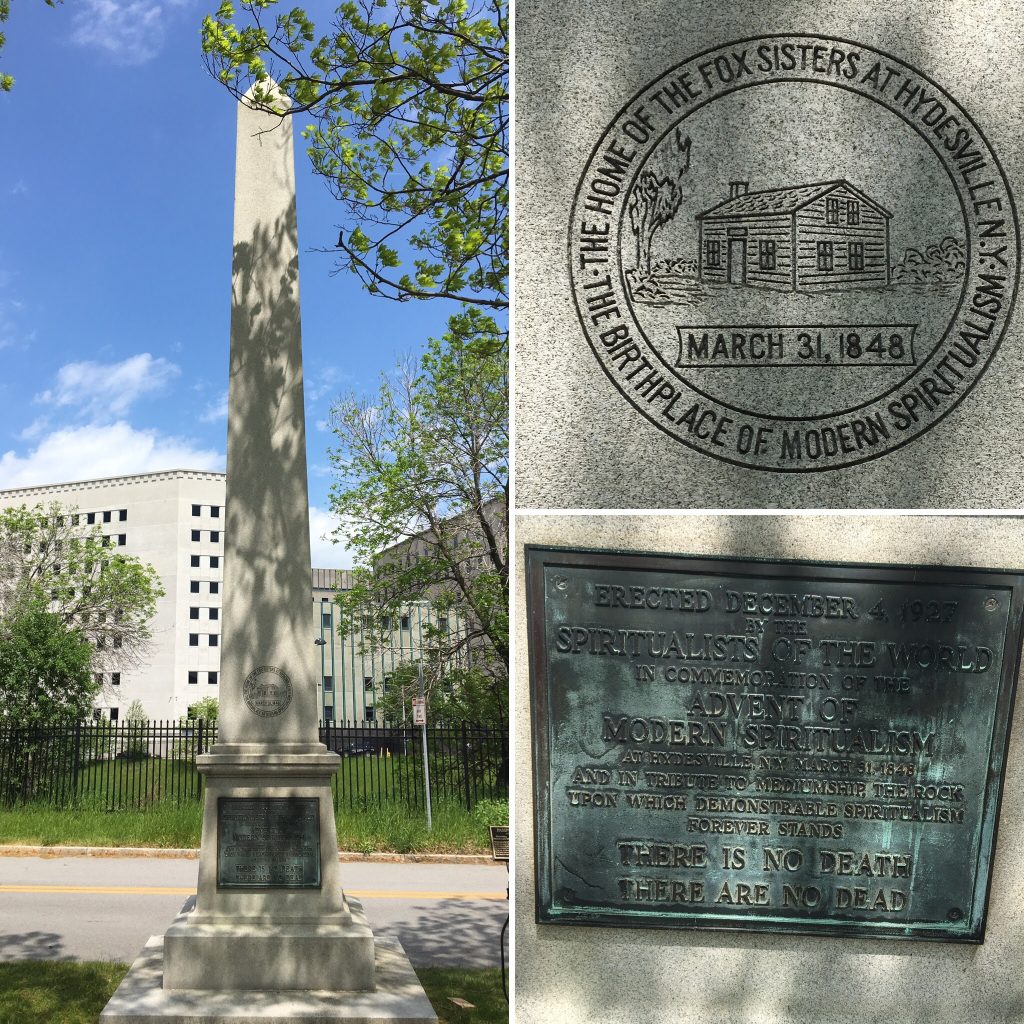
Site #8: In 1927 an obelisk was installed on the south side of the church property to be a memorial honoring the birth of Spiritualism. The obelisk was funded with the help of Arthur Conan Doyle, an ardent believer.
In 1954, I-490 and the Inner Loop project decimated much of downtown Rochester. In the path of the highway were the last two of the Fox’s homes, as well as the church they helped build the spiritual foundation for. The obelisk, thankfully, was saved, and was moved only about 100 feet to the south. Today it stands in a pocket park near the corner of Troup Street and South Plymouth Avenue.
Don’t forget to download the map and go on your own tour of Spiritualist history in Rochester, NY.
Sources
https://en.wikipedia.org/wiki/Erie_Canal
https://en.wikipedia.org/wiki/Burned-over_district
https://en.wikipedia.org/wiki/Second_Great_Awakening
The Missing Link in Modern Spiritualism by Leah Fox Underhill (1885)